Why does weight loss get harder the longer you diet?
Your body treats a caloric deficit like a famine. Within weeks, the thyroid axis dials down — active T3 drops while inactive reverse T3 (rT3) rises and blocks thyroid receptors — lowering cellular ATP turnover. The sympathetic nervous system follows, downregulating UCP1 in brown fat so less energy is dissipated as heat. The result: your metabolism slows to defend your current weight.
How persistent is the metabolic slowdown?
Very. The Biggest Loser 6-year follow-up showed that contestants' metabolisms stayed suppressed years after the competition ended — even after regaining weight. This is why "eat less, move more" fails as a long-term strategy: the body's defenses outlast the diet.
The short version
- The body treats a caloric deficit like a famine: within weeks active T3 drops while inactive reverse T3 rises and blocks thyroid receptors, lowering cellular ATP turnover.
- The sympathetic nervous system then downregulates UCP1 in brown fat so less energy is dissipated as heat, slowing metabolism to defend the current weight.
- The Biggest Loser 6-year follow-up showed contestants' metabolisms stayed suppressed years after the competition, even after regaining weight.
- GLP-1 therapies blunt the starvation-response hormones leptin, ghrelin, and PYY that drive rebound hunger, while a structured lifestyle plan protects muscle and metabolic rate.
- Most patients see meaningful changes by week 4-8 as appetite regulation stabilizes, with the clinical standard being a 3 to 4 month evaluation before continuing or switching.
What actually breaks the cycle?
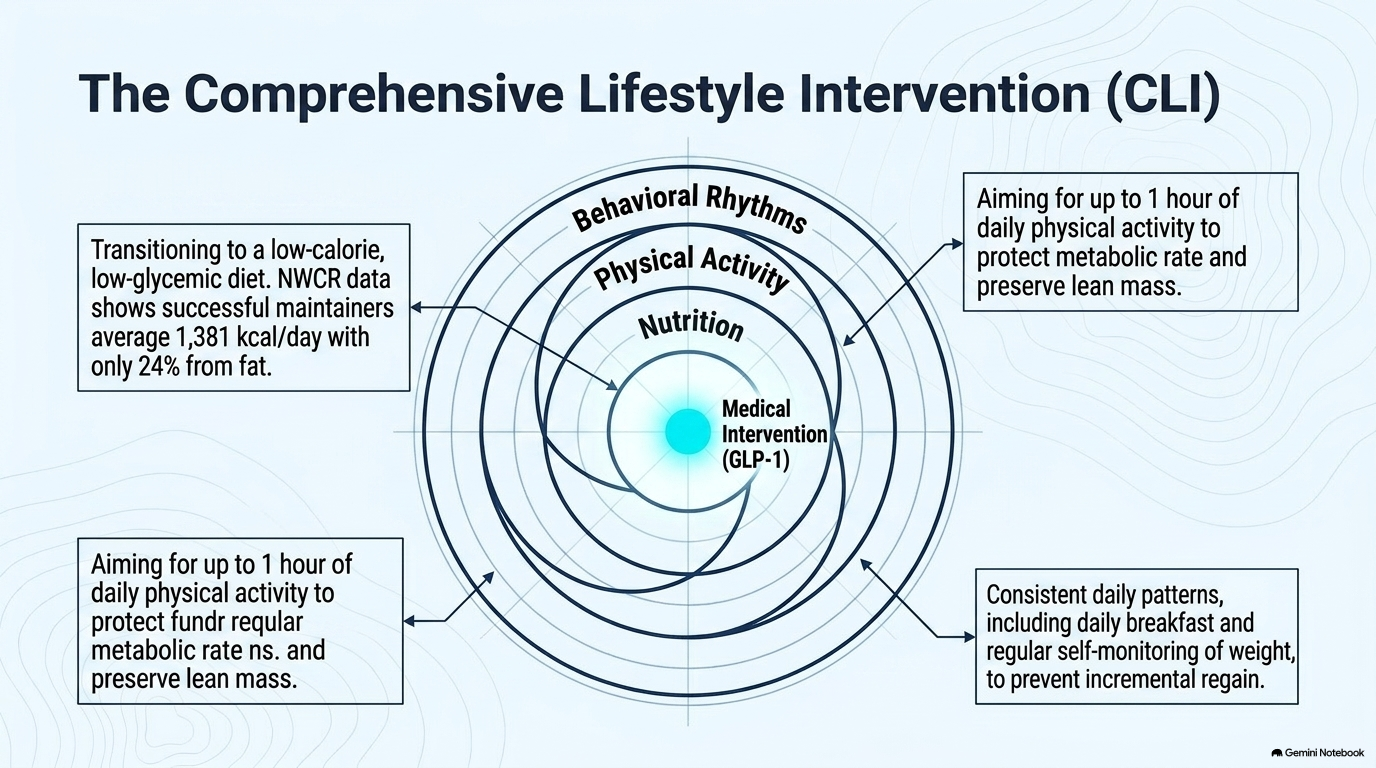
Physician-supervised programs that combine GLP-1 medication with a structured lifestyle plan. GLP-1 therapies blunt the starvation-response hormones (leptin, ghrelin, PYY) that drive rebound hunger, while a comprehensive lifestyle intervention protects muscle and metabolic rate during the deficit. In Boca Raton, weight management programs pair medication with this structured approach — a clinical requirement, not an option.
What should you expect in the first 12 weeks?
Most patients see meaningful changes by week 4-8 as appetite regulation stabilizes. The clinical standard is a 3-4 month evaluation: if weight loss is adequate and side effects are manageable, you continue; if not, dosage adjusts or the medication is switched. Sustainable loss — not crash loss — is the goal.